Sunday, October 7, 2012

day nine - pula and rovinj, croatia

Our last day of touring had arrived. We docked in Pula, the largest city in Istria County, in the morning, and left the ship to meet our guide, Nada.  You may remember that our guide in Korcula was also named Nada.  Different women, but both named "Hope" in Croatian.  I think it says something about the people of this country, that in our small exposure to its residents, two women of a similar age were named Hope.

Pula is known for its shipbuilding, and in fact, Nada's husband is a naval architect.  The large shipyard is the biggest employer in Pula and tourism  is a close second.  Pula has also been Istria's administrative center since ancient Roman times.

And the impact of the Romans was immediately apparent, as we visited the sixth largest Roman amphitheater in the world.  It was originally a small amphitheater built by Claudius and then enlarged by Vespasian in 79 AD for gladiatorial fights.  In Roman times it could hold 23,000 spectators; now it can hold up to 5,000 spectators for concerts and an annual film festival.  We approached from  the pier:


Once inside, we were impressed by the size of building and how much of it remains: 


The metal girders being dismantled by an Italian crew were the remants of an ice hockey game that had been played the night before.  This was a first for the Pula amphitheater, and Nada said her husband and son felt they HAD to be there.

Only a small part of the structure has been cleaned of thousands of years' worth of dirt and grime, but the difference in appearance is striking. Nada said she thinks the rest of the stone cleaning will not be completed for hundreds of years, as the work is so very expensive:


We then went down beneath the seats to the area where the gladiators and the lions prepared to meet each other. The prisons and cages are now a well-lit museum,. We saw rows of amphorae that were used to transport wine and other substances on ships traveling the high seas.  The type of amphorae found at the site of a shipwreck helps archeologists date the wreck.  These containers looked to be in good shape:


We left the amphitheater and continued on our walking tour of the city, passing by a relief map of the city:


Nada pointed out the architectural differences of the buildings nearby, which reflected several different eras and styles.  She also mentioned that 4 generations of men in her family have lived under 7 different governments.  We don't appreciate the stability we have in this country until we hear what others have borne.


We walked along one of the main streets looking at Roman ruins, including the Gate of Hercules. Built in the 1st century BC, it is the oldest and best preserved Roman monument in the city: 


The head of Hercules is in the center and his club is to our left.  Just to the side is what Nada called 1st century graffiti.  Translated from  the Latin, the words essentially say Kilroy Was Here:


We walked past the lovely flower market:


and past the Arch of the Sergii, erected in the 1st century BC on the orders of Salvia Postuma Sergia, to honor three brothers who held important positions in the Roman Empire:


We ended up near the fish market (no, I didn't go anywhere near it), but I did sit on the edge of a fountain while waiting for others to gather, and as I looked across the square I saw this shop:


I got the Charlie part, but had to wait until I got home to translate the "slasticarnica."  It means cake - a perfect translation for Sweet Charlie, our #2 grandson.

Nada led us back to the ship, which was going to sail north to Rovinj, our last stop on this cruise.  One of our group asked Nada if she would like to join us for lunch on the ship, and she thanked us, but said that while we would be sailing for 2 hours to reach Rovinj, she would hop on the fast road and be there in 30 minutes.

Two hours later....we arrived in Rovinj and Nada was there to meet us.  The look of the town was very different from Pula:


Rovinj was originally an island port built by the Romans.  In 1763, Rovinj was joined to the coast by filling in the channel dividing the island from the mainland, creating a peninsula.  In the square in front of the pier is Balbi's Arch (an ancient city gate), dating from 1680, and a late-Renaissance clock tower:


One last peek up one last Croatian sidestreet and we were on our way back to the ship.  Goodbye to Nada and goodbye to Croatia.  We set sail for Venice and we would be traveling home the next day.  More thoughts on that in another post.


Saturday, October 6, 2012

day eight - hvar, croatia

We sailed to the lovely island of Hvar overnight.  After anchoring offshore, we took the tender to the pier in the morning, and again met our guide, Maria, on the island where she was born.  Maria had been with us in Sibenik and Split (where she lives now), and then she took the ferry to Hvar to stay with family overnight before meeting us at the pier.  A lovely woman, Maria is obviously a favorite of the Tauck Tour Directors.

As we walked along the pier to the central square,


we learned that Hvar residents work mostly in the fishing and tourism  industries.  It is also a big draw for the rich and famous as a vacation spot, and even Prince Harry was on Hvar this past summer.  The island's natural beauty, good beaches and mild climate consistently place it on the Conde Nast Traveler magazine's list of top 10 islands.  We were entranced right from the beginning.

At the far end of the square is the Cathedral of Saint Stephan (Katedrala Sv. Sjepana), which has a trefoil pediment and a 17th-century bell tower standing to one side:


After a walk up and down the streets of the small town (where I spotted an interesting looking jewelry shop), we walked through the market on the way to our bus.  Maria, seen kneeling here, explained which local herbs were the best, and told us that lavender, which was introduced in the 1930's, used to be the island's main crop, until a large wildfire a few years ago diminished the annual harvest:


Our bus ride took us to the Spanjola Fortress, a 16th century fort, which for centuries protected the city from  invaders. The views from  the fortress were breathtaking:


and we looked down into the harbour with L'Austral anchored to the rigiht:


Then we departed for the old town of Stari Grad, originally called Pharos and founded by the Syracusans in the 4th century.  This was Maria's hometown, and when one of our fellow travelers told her his daughter-in-law's family was originally from Stari Grad, he learned that Maria's grandmother's maiden name was the same as the daughter-in-law's family name; she and Maria were probably distant cousins.  How small is this world?

We visited the Dominican Monastery, founded in 1482, which had been rebuilt and fortified after destruction by the Turks:


Walking further into town, we saw this lovely gated entrance to an old house:


and determined that the heavenly aromas wafting from this store meant it was not a chiropractic office:


We looked up the old streets, with their shiny, worn cobblestones:


and had some Hvar gelato (good, but that first taste in Venice still takes first place) and then got our picture snapped at the harbour:


Next, we were back on the bus, riding up into the hills of wine country.  The climate and soil of Croatia makes it prime territory for growing grapes and some of their vintages are known throughout the world.  However, you need to taste them in Croatia, because they are not exported at this point.

We were taken to the Konoba Vrisnik (Vrisnik Tavern), located in the very small town of Vrisnik.  This was the tasting area of the winery and the owner of the winery was there to greet us.  Those who tasted said the wines were excellent.  I was more about the gorgeous surroundings:


Throughout this trip, I took pictures of windows.  Each was so different from the next, and each made its own statement.  That's a subject for another blog post (with images of the windows), but here's one of my favorites, from this konoba:


We returned to Hvar and said goodbye to Maria, a really excellent guide who loved to call us "my dearest ladies and gentlemen."  But I wasn't finished with Hvar yet.  I needed to find that jewelry store.  We walked up one side street and found a jewelry shop, but it wasn't the right one.  Then I remembered better where I had seen it and on the second try, we found it.  I must have tried on 10 different necklaces - the clerk was quite the saleswoman and kept putting them on me and changing them out. I finally decided on this one, made in Hvar of fired ceramic sea creatures.  I'll always remember finding it on a special island in the Adriatic and will enjoy wearing it on our favorite island in Florida:


Friday, October 5, 2012

day seven - kotor, montenegro

We docked at Kotor, Montenegro early in the morning.  Operating as a part of the former Yugoslavia and later as a union of Serbia and Montenegro, Montenegro voted for independence from Serbia in 2006.  They are already using the Euro as their monetary standard (Croatia is still using the kuna and hopes to be using the Euro within the next few years) and have a relatively new airport near Kotor which connects this beautiful part of the world with the rest of Europe.  With this infrastructure in place, they are  working hard to increase their tourism business.

Located on a bay at the end of a 15-mile submerged river canyon, Kotor is surrounded by strikingly gorgeous scenery.  Our visit to Kotor began with a bus ride up a very steep road to the village of Njseguse.  Tauck assigns seats in the buses they use, rotating them every day so that guests have an opportunity to sit in all parts of the bus.  Today we were assigned to be in the second row behind our guide, Mira.  This gave us a heart-stopping view of oncoming traffic as we went up (and then back down) through 30 hairpin switchback turns in each direction.  I graciously gave Larry the window seat so that he could catch me as we fell off the cliff!  Believe me when I say I have NEVER been on a bus ride like that one.  The driver was excellent, however, and we all survived.

This gorgeous view of the Bay of Kotor, also known as Boka Bay, greeted us at the top of the mountain:


And to prove we were there, here we are with our new travel friends, Carl and Mimi, and Gene and Rita:


We traveled on to Njseguse, where we went to a small country restaurant to have some of the region's renowned prosciutto-like ham, with cheese, bread and grapes.  The local wine was also available for those who wanted some:


You can even stay overnight in one of their cabins, should you decide you never again want to be on that road to Kotor:


After a nice break and after we were lulled into a sense of carefree relaxation, we once again boarded the bus for a mind-numbing ride down the mountain.  Now I not only needed to stress about going over the cliff but also whether or not the brakes had recently been inspected.  Lordy, lordy...I will never forget this bus ride.

When my eyes were open, I could appreciate the beautiful view:


and was grateful that the driver skillfully avoided a cow/bus collision.  The three animals were being guided by a very elderly woman, who was no match for the bus:


Once back in town, we headed off with Mira to see the town of Kotor, which is one of the best preserved medieval old towns in the Adriatic, and is listed with UNESCO as a world heritage site.  We entered through the city gate:


and were immediately in the Square of Arms:


We saw the Town Clock tower:


and were surprised to see on the attached sign that this was a Clock Tover.  Too bad they didn't have someone proof their sign:


This is the Prince's Palace:


The Cathedral of Saint Tryphon, built in 1166, is nearby:


It had already been a full day, but then we returned to the ship and enjoyed a Tauck-sponsored performance by the female Klapa Singers, a group of nine who had absolutely lovely voices.  They have been given a UNESCO World Heritage designation and performed in traditional costumes.  However, once again there was no explanation in English as to what they were singing about.

At 6:00pm the ship's horn blew three times and we sailed out of Kotor, headed for the island of Hvar, Croatia.  The sail away was perhaps one of the most beautiful we have ever experienced on our many cruises - two hours of sailing in a 15-mile long "fjord" back out to the Adriatic Sea.  We six new friends took up a prime location at the stern of the ship, near the pool, and just reveled in the beauty surrounding us:


There are two islands about half way to the Adriatic, one natural:


and one artificial, made from an old wall of rocks and by sinking seized ships loaded with rocks.  Upon it is the Lady of the Rocks church:


The Captain carefully circled both islands, giving us all a 360 degree view of them and the surrounding area:


We saw one last charming town at the water's edge


and then we were out on the sea.  It certainly had been an interesting day - a death-defying bus ride in the morning and a heavenly, serene sail away in the evening.  We'll never forget either one.

Thursday, October 4, 2012

day six - dubrovnik, croatia

We arrived in the Dubrovnik harbour before breakfast, anchoring at sea.  I lifted this picture of the city and harbour from  the Internet:


Rather a spectacular setting, isn't it?  Until the war broke out in 1991, Dubrovnik was one of the top international tourist destinations of Dalmatia, noted for its beautiful monuments, magnificent wall and welcoming atmosphere.  Founded in the 7th century, the city was ruled by the Romans, the Byzantines and the Venetians over the years.  In 1382 it became the Republic of Ragusa.  There was a serious earthquake in 1667, and much of the old town was rebuilt after that time.  More recently, Dubrovnik was the target of sustained, heavy bombing by Yugoslav troops from the autumn of 1991 until May, 1992.  During this time, over 2000 bombs and guided missles fell on Dubrovnik, and many of the most revered symbols of the Dalmatian culture were damaged.  The war also damaged the city's tourisit industry, which suffered a dramatic decline for 4 years.  UNESCO and the European Union set up a special commission for the reconstruction of the city and much of the damage has been repaired.  Today tourism  is flourishing in Dubrovnik.

We heard much of this information at a special Tauck presentation which began at 8:00am in the ship's theater.  The speaker was Pave Zuban Ruskovic, who had been president of Atlas Travel, a huge travel company in Croatia, and later the Croatian Minister of Tourism:


Mrs. Zuban Ruskovic spoke movingly about her experiences before, during and after the war of the 1990's.  At one point she was brought to tears, as were many in the audience.  The war became very real that morning.  She also spoke of the good things that were happening in Croatia now, including a satellite campus of the RIT Business School in Dubrovnik.  We spoke with her later, as she was seated next to us on the tender ride to the city, and she was most enthusiastic about the RIT program and what it means to the Croatian people.

When our group arrived at the citiy port, we began our guided tour by entering through the Ploce Gate, which dates from the 1300's.  Our first stop was the lovely Dominican Monastery:


The church was plain but beautiful, and featured some spectacular paintings, including a stunning gilded panel by Veneziano from the 14th century:


We exited onto a side street...


and made our way to the very busy Stradun, or main street.  Dubrovnik was almost as busy as Venice:


We got our bearings in the central square and looked up at the Church of St. Blaise, which was rebuilt in the early decades of the 18th century:


We then went to visit the Jewish synogogue, which was located in a small house down a side street.  I was surprised the synogogue was open to the public that day, as it was Yom Kippur.  The ceiling was striking:


There was a room dedicated to the Dubrovnik freedom fighters who were killed during the war of the early 1990's.  Picture after picture of young men lined the walls.  The names of members of the synogogue who died in the war were listed on a special plaque.  At least 5 had the same last name as the family that lived next door to the synogogue and were the caretakers of the building.

We then walked down the Stradun to the Big Fountain of Onofrio, just by the citiy ramparts.  Many in our group planned to walk the walls of the city, over a mile long and with many uneven steps and stairs.  Our knees cried out in protest and we decided to listen to them..


When we saw the 100+ steps going up, we knew we had made the right choice.  You can see the steps going up, with the Church of St. Saviour to the right.  Tiny little people are high up on the walls:


We walked back to the area near the port, where we first began, and visited the Rector's Palace.  This was the seat of government for the Republic of Ragusa, and was designed in the 15th century:


The Rector's Palace now houses the Cultural Historical Museum, which offers an overview of the city's history.  Of course, photos were not allowed inside, so I concentrated on the architecture:


We had a little gelato (!!) after the tour ended and returned to the ship.  Also anchored in the harbour was the Seabourn Spirit:


Later in the afternoon, Tauck presented the Mike Wallace documentary film, "The Death of Yugoslavia," in the ship's theater.  While well done, we walked out of there even more confused about the history of the area and complex issues that brought about the war.

We set sail later in the evening for Kotor, Montenegro.  We'll be visiting our third country of this trip tomorrow.


Wednesday, October 3, 2012

day five - korcula, croatia

This morning we arrived at the island of Korcula (pronounced Korchula), one of the largest islands in the Adriatic.  The main town, also named Korcula, is on an isthmus on the northeast corner of the island.

We met our guide, Nada, and off we went.  We entered through the Land Gate, which was fortified by a huge tower:


Nada explained that the city was built with air conditioning in mind: the narrow streets are arranged in a herringbone pattern off the main street.  To the north, the streets are curved, to lessen the impact of the bora wind, and to the south, the streets are straight, to allow the passage of the mistral into the city.  This charming street is on the south side, allowing the pleasant winds to blow through town:


Korcula hosts a well-regarded Baroque music festival each year, and today was the last day of concerts.  We saw  a stage being erected in one of the smaller city squares:


The central Romanesque-Gothic Cathedral of St. Mark (Katedrala Sv. Marka), built mainly in the 15th century, is undergoing facade renovations, and was covered with green netting:


I especially loved the choir windows, bright with sunlight:


After our tour of the town, we attended a special performance of the Moreska sword dance, which commemorates the clash between Christians and Moors in the attempt to free a gril kidnapped by the infidels.  Unfortunately, my no-flash pictures did not turn out very well, but we lifted one of the short iron swords and appreciated all the heavy lifting being done by the dancers.

On our way back to the ship, I stopped again at a jewelry vendor I had seen going into the Land Gate.  She had interesting looking pieces, silver in color and heavily embellished.  I asked her if she made them  herself and she said no, she got them  from Turkey.  I decided against buying them,, as I felt they were overpriced.  Later, our traveling friend Rita told me she had seen many more vendors selling similar jewelry pieces.  I was glad I had said no.

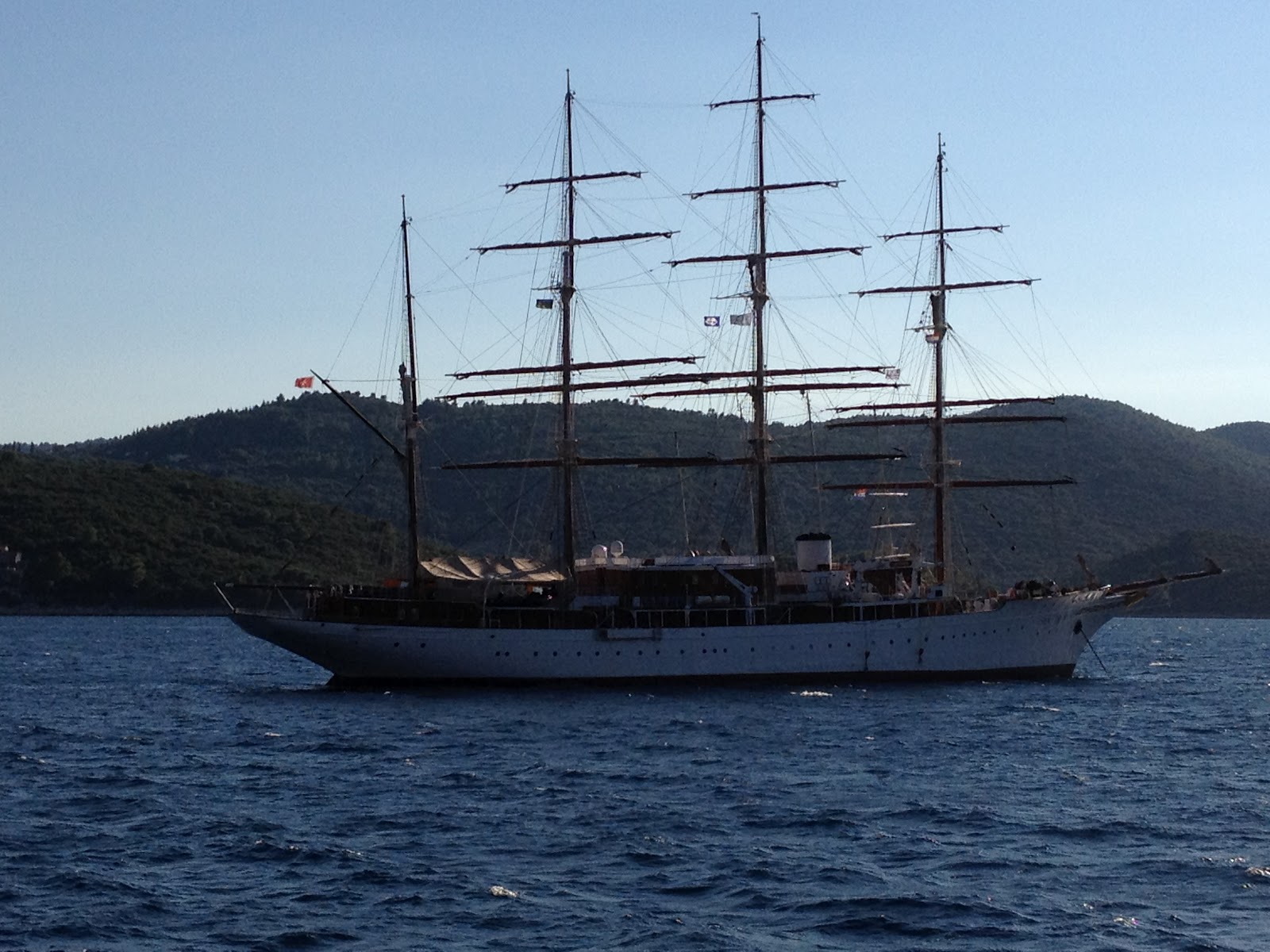
As we returned to our tender, we saw the Sea Cloud anchored out near our ship.  We chatted with one of their crew, who said that National Geographic and Lindblad Travel charter the ship together for about 4 months a year.  He was most interested to hear about our experiences with Tauck, as he was from  Connecticut.


We returned to the ship where we were entertained by a traditional Croatian male quartet.  Their a capella voices were beautifully matched, but there was no information given about their songs.  Since they were singing in Croatian and we were listening in English, there was a serious disconnect.  Perhaps on future Tauck voyages, someone will explain the meaning of the songs.